Setting up NanoClaw
In this lesson, you install NanoClaw and connect it to Telegram. At the end, you have your own AI agent, and you can chat with it on Telegram.
Before you start, finish the Installations lesson. You need Git, Docker and Codex.
Important notes
- This course uses our own copy of NanoClaw. It is a fork: a copy of a project that you can change without changing the original. We changed it with NanoClaw's own skills, so that it works with Telegram and Codex. Our version of Nanoclaw can be found at the aith-nanoclaw-codex-telegram project on GitHub and can be used independently of this course
Setup steps
Step 1: Create your Telegram bot
A bot is an automatic Telegram account. Your agent uses it to chat with you. You make bots with BotFather, Telegram's official bot for making bots.
- In Telegram, search for
@BotFatherand open it. Check that it has a blue tick. Tap Start. - Send
/newbot. - BotFather asks for a name. This is the name people see, for example
Heartlands Helper. - BotFather asks for a username. It must end in
bot, for exampleheartlands_helper_bot. It can only use letters, numbers and underscores (_). You can't change it later. - BotFather replies with a token, like
123456789:AAHdqTcvCH1vGWJxfSeofSAs0K5PALDsaw. The token is your bot's password: anyone who has it can control your bot. Don't share it. You need it in Step 3.
To use your bot in group chats, turn off its Group Privacy setting. With Group Privacy on, the bot only sees messages that mention it.
After the bot is created, open its page in BotFather and scroll down to Bot Settings.
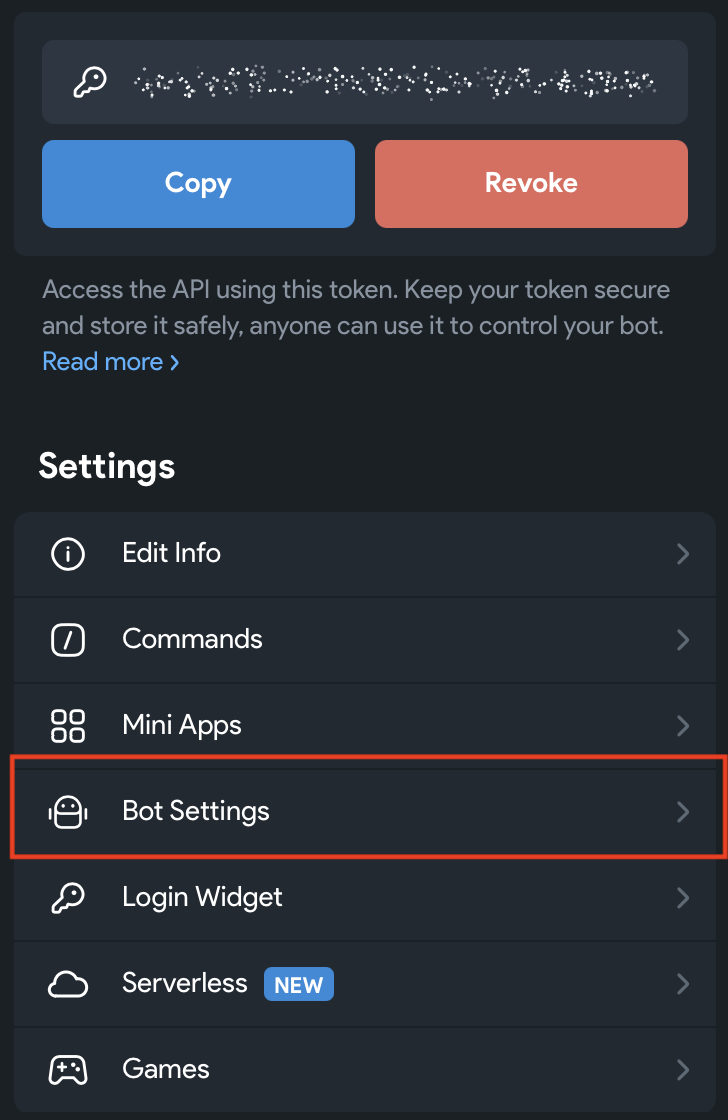
Tap Bot Settings and turn off Group Privacy.
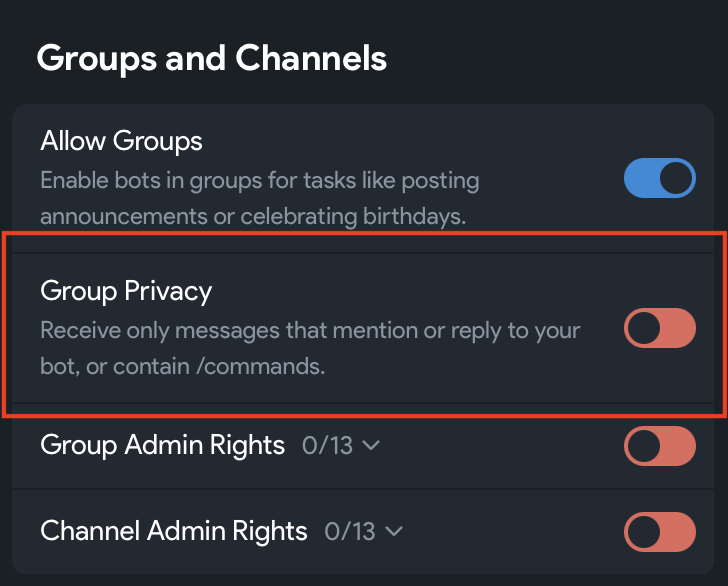
You can also do this in the chat with BotFather: send /mybots, pick your bot, then tap Bot Settings, Group Privacy, and Turn off.
If your bot is already in a group, remove it from the group and add it again. The change only works after that.
Step 2: Download NanoClaw
Run these three commands:
cd ~
git clone https://github.com/aijutsu/aith-nanoclaw-codex-telegram.git nanoclaw
cd nanoclaw
cd ~goes to your home folder. On Windows, this keeps NanoClaw inside Ubuntu, where it runs faster than on your C: drive.git clonedownloads our copy of NanoClaw into a new folder callednanoclaw. You seeCloning into 'nanoclaw'....cd nanoclawmoves you into that folder.
Don't move or rename the nanoclaw folder after setup. NanoClaw names its background service after the folder, and moving it breaks the link.
Step 3: Set up NanoClaw
Your agent runs on Codex. For setup itself, you can use Codex or Claude Code as your helper. The helper shows you NanoClaw's setup skill, and helps you fix things if setup stops with an error. Open the one you use.
NanoClaw comes with skills: instructions that Codex and Claude Code can read. First, see one of them in action.
Codex
You installed Codex in the Installations lesson.
In the
nanoclawfolder, start Codex:bashcodexIf Codex asks whether you trust this folder, say yes.
Type
$setupand press Enter. Codex reads NanoClaw's setup skill. It tells you to runbash nanoclaw.sh.Type
/quitand press Enter to leave Codex. Setup asks you questions as it runs, so you run it yourself, in the terminal.
If setup stops with an error:
- After setup has connected Codex, it asks Want to debug this with Codex? Choose Yes. Codex opens. It already knows what went wrong, and helps you fix it. Type
/quitto go back to setup. - Before that, it asks Claude CLI is needed to diagnose this. Install it now? Claude needs a Claude plan. If you don't have one, choose No. Then start Codex in the
nanoclawfolder and ask it: "Setup failed. Read logs/setup.log and help me fix it."
Claude Code
Claude Code needs a Claude plan: Pro or higher. The free plan doesn't include it. Your agent still runs on Codex, so you also need Codex (from the Installations lesson) and your ChatGPT plan.
Install Claude Code:
bashcurl -fsSL https://claude.ai/install.sh | bashCheck that it works:
bashclaude --versionYou should see a version number, like
2.1.211 (Claude Code). If you seecommand not found, close the terminal, open a new one, and try again.In the
nanoclawfolder, start Claude Code:bashcd ~/nanoclaw claudeThe first time, your browser opens. Sign in to your Claude account, then go back to the terminal. If Claude Code asks whether you trust this folder, say yes.
Type
/setupand press Enter. Claude Code reads NanoClaw's setup skill. It tells you to runbash nanoclaw.sh.Type
/exitand press Enter to leave Claude Code. Setup asks you questions as it runs, so you run it yourself, in the terminal.
If setup stops with an error:
- Before setup has connected Codex, it asks Want to debug this with Claude? Choose Yes. Claude Code opens. It already knows what went wrong, and helps you fix it. Type
/exitto go back to setup. - After that, it offers Codex first: Want to debug this with Codex? Choose Yes to use Codex, and type
/quitto go back to setup.
Before you run setup:
- On a Mac: make sure OrbStack or Docker Desktop is running.
- On Windows: make sure Docker Desktop is running.
- On Windows or Linux: run
sudo -vand type your password. Setup installs some programs, and this lets it do that without stopping to ask.
Now run setup:
bash nanoclaw.sh --agent-provider codex--agent-provider codex tells setup to run your agent on Codex. Without it, setup uses Claude.
Setup installs the rest of what NanoClaw needs, and builds your agent's container. The first build usually takes 3 to 10 minutes. Use the arrow keys to pick an answer, then press Enter. Answer the questions like this:
| Setup asks | Your answer |
|---|---|
| How would you like to begin? | Standard setup |
| How should we create your first agent? | Fresh agent |
| How would you like to connect Codex? | Sign in with my ChatGPT subscription. Sign in in the browser, then go back to the terminal. On Windows, if no browser opens, copy the link into your browser. |
| What should your assistant call you? | Your name |
| What next? | Continue with setup |
| I detected … from your computer settings. Is that right? | Yes, if it shows your time zone |
| Want to chat with your assistant from your phone? | Yes, connect Telegram |
| Connect Telegram? | Yes, connect Telegram |
| What should your assistant be called? | A name for your agent. The default is Nano. |
| How should this telegram account be registered? | Owner |
| Paste the bot token from BotFather | The token from Step 1. It stays hidden while you paste. That is normal. |
| Your pairing code is ready | Open your bot in Telegram and send it the 6 digits, as a private message. |
If setup asks something that isn't in this table, such as an offer of a free NanoClaw account, you can skip it.
When setup is done, it says You're set.
If setup stops with an error, it offers your helper, as described above. You can also run bash nanoclaw.sh --agent-provider codex again: it continues from where it stopped. Setup keeps a record of every step in logs/setup.log.
Step 4: Say hi to your agent
Open Telegram. Your agent has sent you a message in your chat with your bot. Reply to it.
- In your private chat with the bot, your agent answers every message.
- In a group, mention the bot by its username, for example
@heartlands_helper_bot, so that your agent answers.
NanoClaw runs in the background. Your agent only answers while your computer is on and Docker is running.